
The Career Moat: Work in an Uncertain World.
Which capabilities are valuable when roles, technologies, and industries continue to change?
A moat is a protective barrier that makes a castle difficult to attack. In career terms, a moat is the collection of capabilities that continues to create value even as jobs, technologies, industries, and market conditions change.
Large-scale workforce analyses consistently converge on a similar set of durable capabilities. Analytical thinking, complex problem solving, collaboration, communication, learning agility, self-direction, and judgment under uncertainty are among the most consistently valued capabilities across industries, even as technical skill requirements evolve rapidly with automation and artificial intelligence (AAC&U, 2023; Burning Glass Institute, 2024; Deloitte, 2024; LinkedIn, 2024; McKinsey Global Institute, 2023; NACE, 2024; OECD, 2025; World Economic Forum, 2025).
The World Economic Forum estimates nearly 40% of core job skills are expected to change within the next decade due to technological, economic, and organizational transformation (World Economic Forum, 2025). OECD analyses similarly conclude that skill requirements are evolving faster than education cycles, increasing the importance of adaptive problem solving, social coordination, and lifelong learning (OECD, 2025). Research on skills-based hiring indicates employers increasingly prioritize demonstrated capability over credential signals alone, reflecting uncertainty about how well formal degrees capture workplace readiness (Burning Glass Institute, 2024; OECD, 2025).
The AI Question Underneath the Question
In the spring of 2026, the Associated Press ran a story about college students who could not figure out what to major in because of AI.
If the machines can do this, what’s the point of learning it? If the machines are getting better at that, should I bother?
The question underneath the question was something older and harder:
What am I for? (Gecker & Sanders, 2026).
Insights from Zack Kass: Identity Displacement and the Negative Space of AI
Zack Kass, who helped build the commercial case for the large language model economy from inside OpenAI, describes this as a moment of identity displacement more than job displacement (Kass, 2026). His argument is AI is smart, increasingly smart, intellectually equivalent to humans in many dimensions and superior in others.
So, if you want to build a career with staying power, start optimizing for the things the machines are not good at.
He calls this the negative space of AI, the human shape that becomes visible precisely where the machine runs out.
What the machine is doing is sophisticated pattern completion. It does not hold a frame and revise it under pressure. Doesn’t sustain a relationship with accumulated history and stakes. Doesn’t feel the weight of a decision it is responsible for. It has no career, no identity developing through choices, no experience of having been wrong in a way that cost something and changed how it perceives the next situation.
It processes the prompt, generates the response. But there is nobody home. See Zack’s website for more.
Gary Klein spent decades studying what separates genuine expert performance from other performance. The difference was the quality of the mental model, built through real exposure to situations with real stakes and real feedback over time. The firefighter reads the fire because it has taught them something through experience (Klein, 1998). But the large language model reads the fire because someone wrote about fire, and the pattern of that writing has been compressed.
The Dreyfus brothers made this explicit before anyone was talking about AI. Real expertise is not knowing that, which is the accumulation of facts, rules and procedures. It is knowing how, or the embodied, situated capacity that reorganizes perception itself at the highest levels. The expert does not first analyze the situation and then determine what it calls for; they see it as already calling for something (Dreyfus & Dreyfus, 1986). That capacity cannot be compressed and retrieved. It can only be grown, through repeated genuine contact with the conditions that require it.
The ancient Greeks had a useful taxonomy for this. Episteme is theoretical knowledge, universal, context-independent, the kind that can be written down, transmitted, and retrieved. Techne is practical knowledge, craft, skill, the knowing how and knowing when and knowing where that comes from doing the thing in the world repeatedly until perception itself is reorganized. Phronesis is what develops when techne matures into wisdom, practical judgment that is context-sensitive, ethically oriented, and capable of discerning what is appropriate in this situation, with these people, at this moment (Aristotle, Nicomachean Ethics; Schwartz & Sharpe, 2010).
A large language model operates entirely in the domain of knowing how (episteme). LLMs can describe, theorize, synthesize, and systematize across an almost incomprehensible breadth of human knowledge. What it cannot do is develop skill (techne), because that requires a body in the world, repeated genuine contact with conditions that push back, feedback that costs something when you misread it, and the slow reorganization of perception that only accumulates through doing. And it cannot develop judgment (phronesis), because that requires a self, an agent with a history of choices, relationships with stakes, and a developing sense of what matters and why.
This is not a limitation that will be resolved by the next AI model generation. It is structural. The machine can tell you what Aristotle said about practical wisdom and explain the conditions under which judgment develops. It cannot exercise it, because that requires being someone who has something to lose, who has been wrong in ways that cost something, and who has built judgment through the friction of real decisions carried forward through time. That is what these competencies are building toward, the kind of situated, embodied, ethically grounded judgment that the Greeks recognized as the highest form of practical intelligence.
The machine cannot go there. You can.
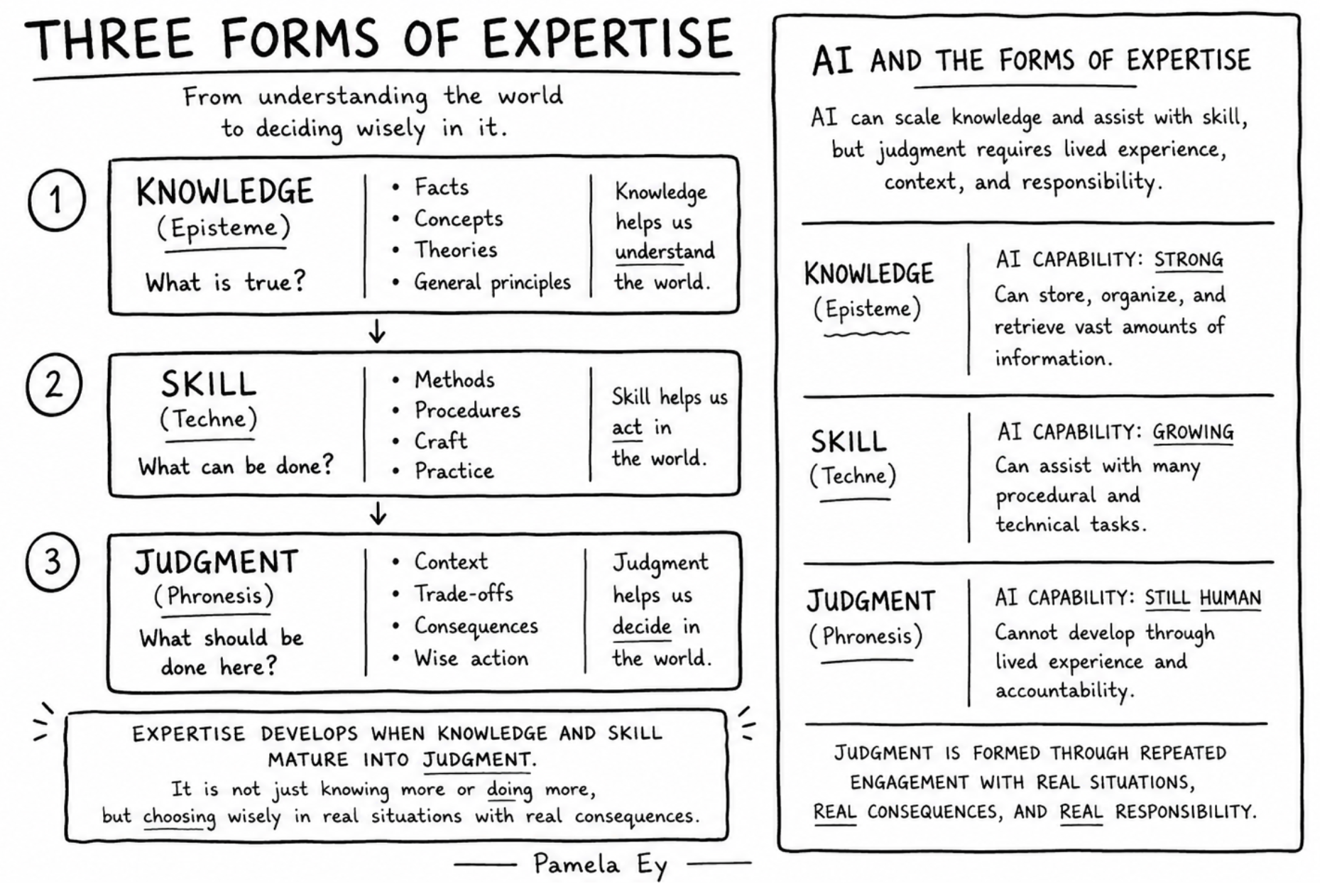
The competencies in this career moat are built for the negative space. According to Kass, they describe the shape of what becomes valuable precisely because the machine cannot replicate it. These competencies are embodied. They are situated and require a self. They depend on the kind of trust that only forms between people who have something at stake with each other. They generate meaning in ways that pattern-matching cannot. And they develop only through the friction of real life, through decisions with real consequences, made with incomplete information, in conditions where something matters.
Neal Kumar Katyal and the Four Teachers
Neal Katyal is one of the most accomplished Supreme Court advocates in American history. In an April 2026 TED talk, he described arguing a case that legal scholars, commentators, and his own colleagues called impossible: persuading the Supreme Court to declare a president's four-trillion-dollar signature initiative unconstitutional, something the Court had never done in 237 years of its history. He won, six to three.
The talk is about how he prepared, and what the preparation revealed about the relationship between human capability and artificial intelligence at the highest levels of performance.
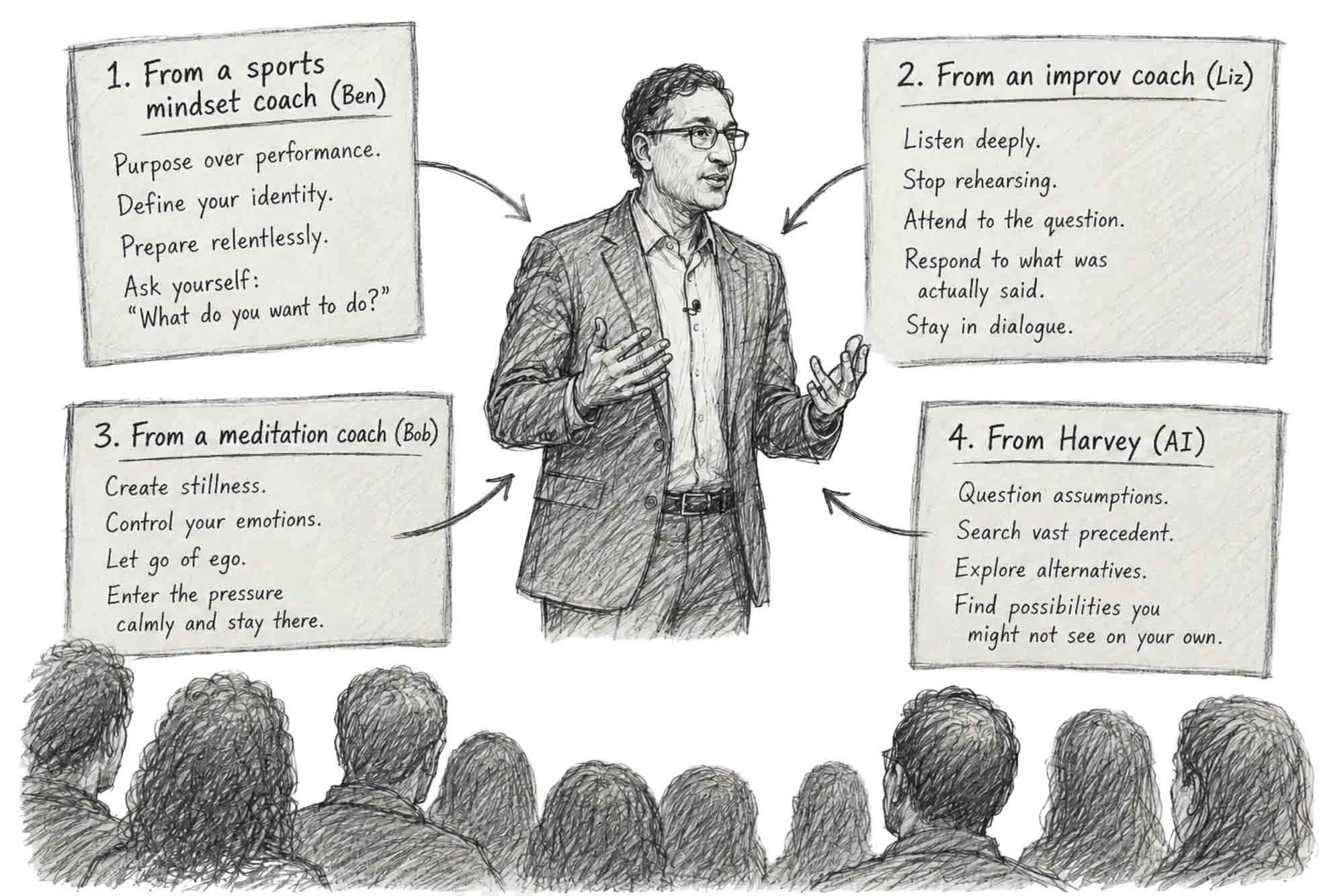
Katyal prepared with four teachers. A sports mindset coach named Ben helped him surface and work with the imposter syndrome he had carried through 52 Supreme Court arguments; the recurring thought, looking at the portraits on the walls, that he didn't belong there. Eighteen hours before the argument, when Katyal said he’s got to do a great job, got to remember 500 things, got to deliver an argument for history, Ben asked him to change one vowel in thinking about his preparation: not what have you got to do, but what do you get to do? The terror transformed into purpose. I get to do something important that few people have ever done.
An improv coach named Liz taught him to listen and to quiet his own thoughts, absorb the question, and trust himself to respond after the other person had spoken. When the justices attacked his argument, he validated their concerns and bridged back. Yes, and. The interrogation became a dialogue.
A meditation coach named Bob gave him stillness; twenty minutes a day on a single word, until the static cleared, and he walked into the courtroom calm and, as he put it, dangerous.
The fourth teacher was Harvey. Harvey read the 200th tariff case the same way as the first. Harvey predicted, almost verbatim, the questions Justice Barrett would ask. Harvey identified how Justice Kavanaugh would press on tariffs versus embargoes. Harvey glimpsed the narrow door; the path by which the Chief Justice could vote against the president and still protect the institution he had spent his career defending. Harvey was an AI: a bespoke system trained on twenty-five years of Supreme Court questions, opinions, concurrences, dissents, and separate writings.
Katyal says AI made the edge that once defined legal expertise or reading, remembering and seeing the most available to anyone. Pattern recognition across vast data is possible. Harvey did that work better than any human researcher could. But Harvey could not win the argument. When Justice Barrett asked a question Harvey hadn't predicted, Katyal truly looked at her, tried to understand the worry underneath the question, and answered the worry. The interrogation became a conversation between two people.
Katyal's conclusion is stop asking whether AI will replace you and start asking what you do that AI cannot. His answer and the Career Moat's answer is the same. The irreducibly human work is judgment that is situated, relational, and carried forward through time by someone with something at stake. That is what these competencies are building toward.
Katyal is one of the best-prepared people in his field, operating at the highest-stakes venue his profession offers, using AI deliberately and without illusion about what it is, and winning because of what he brought that the AI could not. Ben, Liz, and Bob, reframing, listening, and stillness, are the human work that made the AI useful. Harvey asked the questions. The humans found the answers. That is the architecture the Career Moat is built to develop.
The Career Moat Competencies
| Competency | Core Question |
|---|---|
| 1. Sensemaking | What is happening? |
| 2. Critical Thinking | What should I believe and what should I question? |
| 3. Complex Problem Solving | What should I do when no clear solution exists? |
| 4. Strategic Thinking | How does this evolve across time, systems, and competing forces? |
| 5. Collaboration | How do we build shared understanding together? |
| 6. Communication | How do I make my reasoning visible and useable for others? |
| 7. Coaching and Development | How do I build capability in others? |
| 8. Learning Agility | How do I improve judgment from experience? |
| 9. Professional Agency | What deserves my effort and ownership? |
| 10. Technology and AI fluency | How do I use tools without surrendering judgment? |
In this document, competencies are bundles of knowledge, skills, and other attributes that belong to the individual and support effective performance under real conditions. Employers may define which competencies matter for success in each role, and the core competencies needed by everyone for a distinct competitive advantage, but the competencies themselves are person-level capacities. The purpose for this work is building people, one at a time, for a world shaped by complexity, ambiguity, uncertainty, and constraint.
Competencies are portable because they apply across roles, industries, and contexts. They are forward-looking, describing bundles of knowledge, skills, and attributes required to function effectively in evolving environments. This makes them valuable both for individuals building a durable career edge and for organizations intentionally developing the capacity of their workforce, including increasingly human–AI teams.
Competence is an ongoing process expressed through action, including how a person interprets situations, makes decisions, coordinates with others, and adapts over time. So behavioral indicators are useful, because they provide observable signals that allow competence to be recognized and developed in a consistent fair way.
Competencies also give us a shared language for expectations. For organizations, competencies clarify what effective performance looks like. For individuals, they make development pathways more visible and navigable.
How does it all work?
Competencies
Competencies are the outcomes. These are underlying characteristics, ways of reading situations, generating responses, and adapting under pressure, that distinguish effective from ineffective performance across contexts. They are learnable, developmentally progressive, and measurable. They develop through repeated genuine engagement with the conditions that require them, with real stakes, real feedback, and the cognitive rewards that come from navigating them well. The learning units architecture is the mechanism, habits are the pattern, competencies are the observable capability.
Sub-competencies
Sub Competencies are the focused bundles of knowledge, skills, and other attributes like habits. Sub-competencies are component of broader competencies. Sub-competencies are the granular level where instructional design happens, and development can be measured. Five habits support building the sub competencies.
Learning units
Are a library of ~ 500 resources categorized as:
Mental models
Strategies
Processes
Dispositions
Concepts/frameworks
Prompts
Theories
Structured Methods
These are guided by a teaching/learning taxonomy by resource types. For example, mental models require recognition before application. Prompts are trigger conditions. Processes require repeated practice.
All of it is organized as a system with multiple entry points to the same underlying capability: building expertise for navigating complexity, uncertainty, ambiguity and constraint. The same library of resources can be used differently depending on:
who the client is
what situation they are in
what level of expertise they already have
whether the goal is solving a problem or building capability
how the learning must transfer into action
Developmental Progression (expertise pathway)
People do not begin at the same place, and the same learning unit functions differently depending on where someone is in their development.
The Dreyfus model of skill acquisition describes the progression: a novice consciously follows rules and needs explicit structure; an advanced beginner starts recognizing patterns; a competent performer makes deliberate choices and justifies them; a proficient performer perceives situations holistically and detects when something is wrong; an expert reads the situation immediately and acts from fluid, integrated judgment (Dreyfus & Dreyfus, 1986).
Early on, learning units work as external supports. A framework tells you what to look for. A prompt redirects your attention. A process walks you through a decision. At this stage the goal is developing enough vocabulary and structure to recognize what kind of situation you are in and ask better questions before committing to action.
With experience, the same tools begin to shape perception rather than just guide behavior. You start recognizing patterns across situations that look different on the surface. You notice when your initial interpretation might be wrong before you have acted on it. You begin to anticipate second-order effects rather than only reacting to first-order ones.
At higher levels of development, the tools become part of how you see. You perceive through a mental model rather than simply applying it. Judgment becomes fluid and context-sensitive, adapted in real time as conditions change. At this stage the most valuable contribution is often helping others develop the same capability.
Seymour Papert’s insight applies throughout: You can only learn what you are ready to learn (Papert, 1980). Knowledge encountered before the experiential foundation exists to receive it produces recognition at best, not genuine reorganization of understanding. The readiness to learn from a tool is built through using it under real conditions. You are the skill builder. The system can organize the resources and name the path. The development happens through you, in the doing.
Want to Dive Deeper?
Learn more about the Career Moat, access hundreds of resources, or get help applying this to your unique situation.
References
Adamson, D., Dyke, G., Jang, H., & Rosé, C. P. (2014). Towards an agile approach to adapting dynamic collaboration support to student needs. International Journal of Artificial Intelligence in Education, 24(1), 92–124.
Alluisi, E. A. (1991). The development of technology for collective training: SIMNET, a case history. Human Factors, 33, 343–362.
Anderson, J. R., Corbett, A. T., Koedinger, K. R., & Pelletier, R. (1995). Cognitive tutors: lessons learned. The Journal of the Learning Sciences, 4(2), 167–207.
Andres, H. (2002). A comparison of face-to-face and virtual software development teams. Team Performance Management, 8(1/2), 39–48.
Axelrod RM. (1976). Structure of decision: the cognitive maps of political elites. Princeton University Press, Princeton, NJ.
Bettis RA, Prahalad CK. (1995). The Dominant Logic: Retrospective and Extension. Strategic
Management Journal 16(1), 5-14.
Bibby, P.A. (1992). Mental models, instruction and internalization. In Y. Rogers, A. Rutherford & P. A. Bibby (Eds.), Models in the Mind: Theory, Perspective and Application (pp. 154-172). London: Academic Press.
Blickensderfer, E., Cannon-Bowers, J. A., & Salas, E. (1997). Theoretical bases for team self-correction: Fostering shared mental models. In M. Beyerlein, D. Johnson, & S. Beyerlein (Eds.) Advances in interdisciplinary studies of work teams: Vol.4. Team implementation (pp. 249-279). Greenwich: JAI Press.
Bloom, B. S. (1984). The 2 sigma problem: the search for methods of group instruction as effective as one-to- one tutoring. Educational Researcher, 13, 4–16.
Brown (1986). From cognitive to social ergonomics and beyond. In D.A. Norman & S. W. Draper (Eds.), User Centered System Design: New Perspectives on Human-Computer Interaction (pp. 457-486). Hillsale, NJ: LEA.
Brown, A., & Palincsar, A. (1989). Guided, cooperative learning and individual knowledge acquisition. In L. B. Resnick (Ed.), Knowing, learning, and instruction: Essays in honor of Robert Glaser (pp. 393–451). Hillsdale: Erlbaum.
Burke, C. S., Stagl, K. C., Klein, C., Goodwin, G. F., Salas, E., & Halpin, S. M. (2006). What type of leadership behaviors are functional in teams? A meta-analysis. The Leadership Quarterly, 17, 288–307. doi:10.1016/j.leaqua.2006.02.007.
Burton, M. (1998). Computer modeling of dialogue roles in collaborative learning activities. (Unpublished doctoral dissertation). Computer-Based Learning Unit, University of Leeds, Leeds.
Cannon-Bowers, J. A., & Bowers, C. (2011). Team development and functioning. In S. Zedeck (Ed.), APA handbook of industrial and organizational psychology, Vol 1: Building and developing the organization (pp. 597–650). Washington, DC: American Psychological Association.
Cannon-Bowers, J. A., & Salas, E. (2001). Reflections on shared cognition. Journal of Organizational Behavior, 22, 195–202.
Cannon-Bowers, J. A., Salas, E., & Converse, S. A. (1990). Cognitive psychology and team training: Shared mental models in complex systems. Human Factors Society Bulletin, 33(12), 1–4.
Cannon-Bowers, J. A., Salas, E., & Converse, S. A. (1993). Shared mental models in expert team decision making. In N. J. Castellan Jr. (Ed.), Current issues in individual and group decision making (pp. 221– 246). Hillsdale: Erlbaum.
Carbonell, J. R. (1970). AI in CAI: an artificial intelligence approach to computer-assisted instruction. IEEE Transactions on Man-Machine Systems, 11, 190–202.
Card, S., & Moran, T. (1986). User technology: from pointing to pondering. Proceedings of the ACM Conference on the History of Personal Workstations, 183-198.
Chidambaram, L. (1996). Relational development in computer-supported groups. MIS Quarterly, 20(2), 143163.
Cooke, N. J., Salas, E., Cannon-Bowers, J. A., & Stout, R. (2000). Measuring team knowledge. Human Factors, 42, 151–173.
Cooke, N. J., Gorman, J. C., Myers, C. W., & Duran, J. L. (2012). Interactive team cognition. Cognitive Science, 37, 255–285. doi:10.1111/cogs.12009.
Corbett, A. (2001). Cognitive computer tutors: solving the two-sigma problem. In M. Bauer, P. J. Gmytrasiewicz, & J. Vassileva (Eds.), User Modeling (pp. 137–147). Berlin: Springer-Verlag.
DeChurch, L. A., & Mesmer-Magnus, J. R. (2010). The cognitive underpinnings of effective teamwork: a meta-analysis. Journal of Applied Psychology, 95(1), 32–53.
Dodds, P. V. W., & Fletcher, J. D. (2004). Opportunities for new Bsmart^ learning environments enabled by next generation web capabilities. Journal of Education Multimedia and Hypermedia, 13(4), 391–404.
Ehrlich, K. (1996). Applied mental models in human-computer interaction. In J. Oakhill & A. Garnham (Eds.), Mental Models in Cognitive Science (pp. 223-245). Hove, East Sussex, U.K.: Psychology Press.
Espevik, R., Johnsen, B., & Eid, J. (2011a). Communication and performance in co-located and distributed teams: an issue of shared mental models of team members? Military Psychology, 23(6), 616–638.
Espevik, R., Johnsen, B. H., & Eid, J. (2011b). Outcomes of shared mental models of team members in cross training and high-intensity simulations. Journal of Cognitive Engineering and Decision Making, 5(4), 352–377.
Feurzeig, W. (1969). Computer Systems for Teaching Complex Concepts (BBN Report 1742). Cambridge: Bolt Beranek & Newman, Inc. (DTIC AD 684 831).
Fiore, S. M., Rosen, M. A., Smith-Jentsch, K. A., Salas, E., Letsky, M., & Warner, N. (2010). Toward an understanding of macrocognition in teams: predicting processes in complex collaborative contexts. Human Factors, 52(2), 203–224.
Fletcher, J. D. (1975). Models of the learner in computer-assisted instruction. Journal of Computer-Based Instruction, 3, 118–126.
Fletcher, J. D. (1992). Individualized systems of instruction. In M. C. Alkin (Ed.), Encyclopedia of educational research (Sixth ed., pp. 613–620). New York: Macmillan.
Fletcher, J. D. (2009). Education and training technology in the military. Science, 323, 72–75.
Fletcher, J. D., & Rockway, M. R. (1986). Computer-based training in the military. In J. A. Ellis (Ed.), Military contributions to instructional technology (pp. 171–222). New York: Praeger.
Fletcher, J.D. & Sottilare, R. (2013). Shared mental models of cognition for intelligent tutoring of teams. In R. Sottilare, A. Graesser, X. Hu, & H. Holden (Eds.) Design Recommendations for intelligent tutoring systems: Volume 1- Learner Modeling. Orlando: Army Research Laboratory. ISBN 978-0-9893923-0-3.
Fletcher, J. D., Tobias, S., & Wisher, R. L. (2007). Learning anytime, anywhere: advanced distributed learning and the changing face of education. Educational Researcher, 36(2), 96–102.
Goldberg, B., Brawner, K. Sottilare, R., Tarr, R., Billings, D., & Malone, M. (2012). Use of evidence-based strategies to expand extensibility of adaptive tutoring technologies. In Proceedings of the Interservice/ Industry Training Simulation & Education Conference, Orlando.
Gorman, J. C. (2014). Team coordination and dynamics: two central issues. Current Directions in Psychological Science, 23(5), 355–360. Graesser, A., D’Mello, & Cade, W. (2011). Instruction based on tutoring. In R. E. Mayer & P. A. Alexander (Eds.), Handbook of research on learning and instruction (pp. 408–426). New York: Routledge.
Grand, J. A., Braun, M. T., Kuljanin, G., Kozlowski, S. W., & Chao, G. T. (2016). The dynamics of team cognition: a process-oriented theory of knowledge emergence in teams. Journal of Applied Psychology, 101(10), 1353.
Guimera, R., Uzzi, B., Spiro, J., & Amaral, L. A. N. (2005). Team assembly mechanisms determine collaboration network structure and team performance. Science, 308(5722), 697–702.
Hirst, G. (2009). Effects of membership change on open discussion and team performance: the moderating role of team tenure. European Journal of Work and Organizational Psychology, 18(2), 231–249.
Hodgkinson GP, Maule AJ, Bown NJ. (2004). Causal Cognitive Mapping in the Organizational Strategy Field: A Comparison of Alternative Elicitation Procedures. Organizational Research Methods 7(1), 3.
Hoffman, R. R., Shadbolt, N. R., Burton, A. M., & Klein, G. (1995). Eliciting knowledge from experts: A methodological analysis. Organizational Behavior and Human Decision Processes, 62(2), 129–158.
Huff, A.S. (1990). Mapping strategic thought. Wiley: New York and Chichester.
Inzana, C. M., Driskell, J. E., Salas, E., & Johnston, J. H. (1996). The effects of preparatory information on enhancing performance under stress. Journal of Applied Psychology, 81, 429–435. James, W. (1890/1950). Principles of psychology: Volume I. New York: Dover Press.
Johnson-Laird, P. N. (1983). Mental models: Towards a cognitive science of language, inference, and consciousness. Harvard University Press.
Jones, M. B. (1974). Regressing group on individual effectiveness. Organizational Behavior and Human Performance, 11, 426–451. Kozlowski, S. W. J., & Ilgen, D. R. (2006). Enhancing the effectiveness of work groups and teams. Psychological Science in the Public Interest, 7(3), 77–124.
Kahneman, D., & Klein, G. (2009). Conditions for intuitive expertise: A failure to disagree. American Psychologist, 64(6), 515–526.
Kulik, J. A., & Fletcher, J. D. (2016). Effectiveness of intelligent tutoring systems: a meta-analytic review. Review of Educational Research, 86, 42–78.
Landon, L. B., Vessey, W. B., & Barrett, J. D. (2016). Evidence report: risk of performance and behavioral health decrements due to inadequate cooperation, coordination, communication, and psychosocial adaptation within a team. Houston: Johnson Space Center.
Lewis, M. (2004). Moneyball: The art of winning an unfair game. New York: W. W. Norton.
Marks, M. A., Mathieu, J. E., & Zaccaro, S. J. (2001). A temporally based framework and taxonomy of team processes. Academy of Management Review, 26, 356–376.
Mathieu, J. E., Marks, M. A., & Zaccaro, S. J. (2001). Multi-team systems. In N. Anderson, D. S. Ones, H. K. Sinangil, & C. Viswesvaran (Eds.), Organizational psychology: Vol. 2. Handbook of industrial, work and organizational psychology (pp. 289–313). London: Sage.
McManus, M. M., & Aiken, R. M. (1995). Monitoring computer-based collaborative problem solving. International Journal of Artificial Intelligence in Education, 6(4), 307-336.
McManus, M. M., & Aiken, R. M. (2016). Supporting effective collaboration: using a rearview mirror to look forward. International Journal of Artificial Intelligence in Education, 26(1), 365–377.
Moore, N.K., Squire, K.M., & Blocker, R.C. (2015). Examining the successful outcomes of multidisciplinary teamwork in a code situation using the shared mental model framework. Proceedings of the human factors and ergonomics Society 59th annual meeting. Human Factors and Ergonomics Society. doi: 10.1177 /1541931215591110.
Morrison, J. E., & Meliza, L. L. (1999). Foundations of the After Action Review Process (IDA Document D-2332). Alexandria: Institute for Defense Analyses.
Norman, D. A. (1983). Some observations on mental models. In D. Gentner & A. L. Stevens (Eds.), Mental Models (pp. 7-14). Hillsdale, NJ: Erlbaum.
Novak, J. D., & Cañas, A. J. (2006). The origins of the concept mapping tool and the continuing evolution of the tool. Information Visualization, 5, 175–184.
Olmstead, J. A. (1992). Battle Staff Integration (IDA Paper P-2560). Alexandria: Institute for Defense Analyses. (DTIC/NTIS No. ADA 248 941).
Pettigrew, A. M. (1979). On studying organizational cultures. Administrative Science Quarterly, 24(4), 570– 581.
Rasmussen, J. (1979). On the Structure of Knowledge – A Morphology of Mental Models in Man-Machine System Context (Tech. Rep. No. Riso-M-2192). Roskilde, Denmark: Riso National Laboratory. (Cited from Rouse and Morris, 1986)
Rasmussen, J. (1986). Information Processing and Human-Machine Interaction. Amsterdam: North-Holland.
Rehder B. (2003). Categorization as causal reasoning. Cognitive Science 27(5): 709-748.
Roby, T. L., & Lanzetta, J. T. (1958). Considerations in the analysis of group tasks. Psychological Bulletin, 55, 88–101.
Rouse, W. B., & Morris, N. M. (1986). On looking into the black box: prospects and limits in the search for mental models. Psychological Bulletin, 100, 349–363.
Salas, E., & Cannon-Bowers, J. A. (2000). The anatomy of team training. In S. Tobias & J. D. Fletcher (Eds.), Training and retraining: a handbook for business, Industry, government, and the military (pp. 312–335). New York: Macmillan.
Salas, E., Diaz Granados, D., Klein, C., Burke, C. S., Stagl, K. C., Goodwin, G. F., & Halpin, S. M. (2008). Does team training improve team performance? A meta-analysis. Human Factors, 50(6), 903–933. Salas, E., Rosen, M. A., Held, J. D., & Weissmuller, J. J. (2009). Performance measurement in simulation-based training: A review and best practices. Simulation and Gaming: An Interdisciplinary Journal, 40(3), 328–376.
Salas, E., Benishek, Coultas, C., Dietz, A., Grossman, R., Lazzara, E., & Oglesby, J. (2015). Team training essentials. Routledge.
Sanderson, P. M. (1990). Knowledge acquisition and fault diagnosis: Experiments with PLAULT. IEEE Transactions on Systems, Man and Cybernetics 20, 225-242.
Scheirer, J., Klein, J., Fernandez, R., & Picard, R. W. (2002). Frustrating the user on purpose: a step toward building an affective computer. Interaction with Computers., 14(2), 93–118.
Senge
Simon, H.A. (1991). Bounded rationality and organizational learning. Organization Science 2(1): 125-134
Soller, A. (2001). Supporting social interaction in an intelligent collaborative learning system. International Journal of Artificial Intelligence in Education, 12(1), 40–62.
Soller, A., Linton, F., Goodman, B., & Gaimari, R. (1998). Promoting effective peer interaction in an intelligent collaborative learning environment. In Proceedings of the 4th international conference on intelligent tutoring systems (ITS ‘98) (pp 186–195). San Antonio.
Sottilare, R. (2012). Considerations in the development of an ontology for a generalized intelligent framework for tutoring. International Defense & Homeland Security Simulation Workshop in Proceedings of the I3M Conference. Vienna, September 2012.
Sottilare, R., Holden, H., Brawner, K., & Goldberg, B. (2011). Challenges and emerging concepts in the development of adaptive, computer-based tutoring systems for team training. In Proceedings of the Interservice/Industry Training Systems & Education Conference, Orlando, December 2011.
Sottilare, R.A., Brawner, K.W., Goldberg, B.S. & Holden, H.K. (2012). The Generalized Intelligent Framework for Tutoring (GIFT). Orlando: U.S. Army Research Laboratory – Human Research & Engineering Directorate (ARL-HRED).
Sottilare, R., Ragusa, C., Hoffman, M. & Goldberg, B. (2013). Characterizing an adaptive tutoring learning effect chain for individual and team tutoring. In Proceedings of the Interservice/Industry Training Simulation and Education Conference; 2013, Orlando.
Sottilare, R., Burke, S., Johnston, J., Sinatra, A., Salas, E., & Holden, H. (2015). Antecedents of adaptive collaborative learning environments. In Proceedings of the Interservice/Industry Training Simulation & Education Conference, Orlando, December 2015.
Sterman, J.D. (1989b). Modeling Managerial Behavior: Misperceptions of Feedback in a Dynamic Decision Experiment. Management Science 35(3): 321-339.
Tannenbaum, S., Smith-Jentsch, K., & Behson, S. (1998). Training team leaders to facilitate team learning and performance. In A. Cannon-Bowers & E. Salas (Eds.), Making decisions under stress: Implications for individual and team training (pp. 247–270). Washington, DC: American Psychological Association.
Van den Bossche, P., Gijselaers, W. H., Segers, M., & Kirschner, P. A. (2006). Social and cognitive factors driving teamwork in collaborative learning environments: team learning beliefs and behaviors. Small Group Research, 37(5), 490–521.
VanLehn, K. (2011). The relative effectiveness of human tutoring, intelligent tutoring systems, and other tutoring systems. Educational Psychologist, 46(4), 197–221.
Vygotsky, L. S. (1978). Mind in Society: the development of higher psychological processes. Cambridge: Harvard University Press.
Warkentin, M., Sayeed, L., & Hightower, R. (1997). Virtual teams versus face-to-face teams: an exploratory study of a web-based conference system. Decision Sciences, 28(4), 975–996.
Wegner, D. M. (1986). Transactive memory: a contemporary analysis of the group mind. In G. Mullen & G. Goethals (Eds.), Theories of group Behavior (pp. 185–208). New York: Springer-Verlag.
Yerkes, R. M., & Dodson, J. D. (1908). The relation of strength of stimulus to rapidity of habit-formation. Journal of Comparative Neurology and Psychology, 18, 459–482.
Yoo, Y., & Kanawattanachai, P. (2001). Developments of transactive memory systems and collective mind in virtual teams. The International Journal of Organizational Analysis, 9(2), 187–208.