
Everyone Needs to Know How Learning Works
And this is how it doesn’t.
Every day, people make decisions about learning. They design training programs, onboard new hires, prepare others for high-stakes work, support children in school, or try to build new skills themselves. Those decisions shape performance, safety, confidence, and long-term capability.
Most of those decisions are made without a workable model of how learning actually happens.
When people lack a correct idea of how learning works, they do what humans reliably do in complex domains: they explain outcomes using what feels intuitive, visible, and socially reinforced. Over time, those explanations harden into learning myths, or the ideas that sound reasonable, spread easily, and persist even when evidence contradicts them (Bransford et al., 2000; De Bruyckere et al., 2015).
Learning science has decades of study about why and how this happens.
Why Learning Myths Persist
From a scientific standpoint, learning presents a basic problem: its most important outcomes are invisible. The brain’s working processes of understanding, judgment, and the ability to transfer knowledge to new situations cannot be directly observed. What can be observed are surface signals like activity, preference, time spent, engagement, confidence, completion (Bransford et al., 2000).
In the absence of a clear account of underlying cognitive mechanisms, people rely on those surface cues as explanations rather than indicators. Descriptive tools, partial findings, and good metaphors are used as causal models. What begins as a reasonable shortcut (assumption) becomes common sense (belief) through repetition and professional endorsement (Kirschner et al., 2006; Kirschner & van Merriënboer, 2013).
Across the learning sciences, scholars converge on the idea that learning myths do not hang on because people are careless or anti-science. They won’t die because intuitive explanations are filling a theory gap. When visible cues or simplified representations are asked to explain outcomes they were never designed to explain, they become myths (Pashler et al., 2008; De Bruyckere et al., 2015).
The myths here are different expressions of the same underlying mistake.
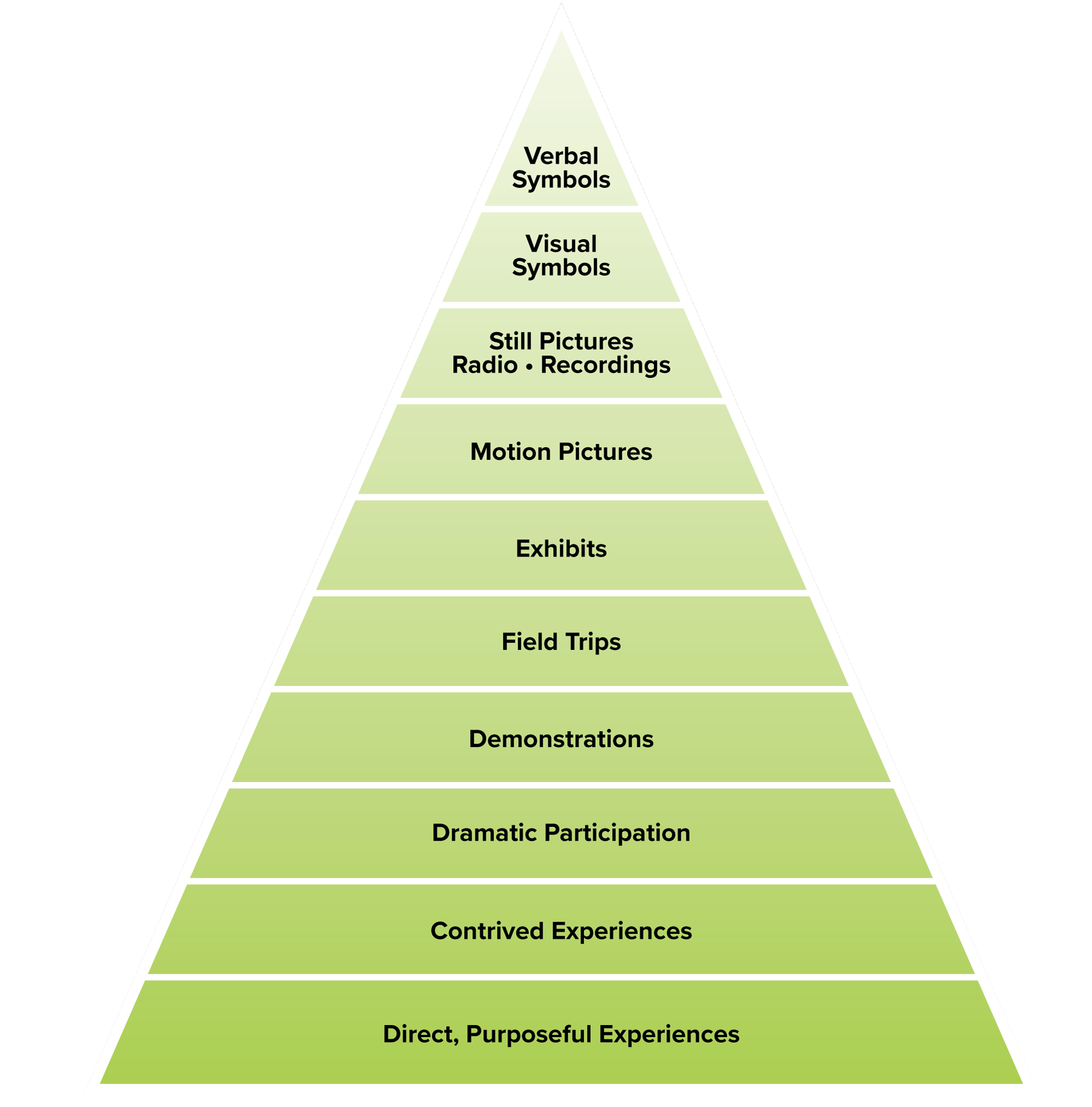
Myth 1: The Cone of Experience Explains How Learning Works
One of the most enduring learning myths is that Edgar Dale’s Cone of Experience explains how learning happens. It is often presented as a ranked model of instructional effectiveness, complete with precise retention percentages attached to different activities about what people remember from reading, hearing, seeing, discussing, doing.
That interpretation is wrong.
Dale never proposed retention rates. He did not claim that learning improves as instruction becomes more active. The cone was a classification of instructional experiences, not a theory of learning, memory, or transfer. It described types of experiences, not how to design learning so it will stick (Dale, 1946; De Bruyckere et al., 2015).
The problem is not the cone itself. The problem is how it is used.
When a descriptive diagram is treated as a causal model, it’s easy to use the model as if it was a recipe. Numbers are added to create the appearance of precision, and visual simplicity substitutes for theory. A tool meant to organize experiences becomes an explanation for outcomes it was never meant to explain (De Bruyckere et al., 2015).
What research shows instead is learning depends on cognitive processes, not instructional forms like reading, hearing, seeing, and doing. Retrieval, elaboration, comparison, feedback, and integration with prior knowledge are what drive learning and transfer. Activities matter only insofar as they reliably help those processes along (Bransford et al., 2000; Brown et al., 2014).
Myth 2: Learning Styles - Learning Improves When Instruction Matches Preferences
Another belief that won’t die is that learning improves when instruction is matched to individual learning styles of visual, auditory, kinesthetic, and similar categories.
The appeal is easy to understand. The idea feels respectful and learner-centered. The problem is treating preference as a learning mechanism.
Decades of research show no credible evidence that matching instruction to learning styles improves learning outcomes. Preference does not determine how information is processed, organized, or retrieved. Learning effectiveness depends on task demands, prior knowledge, and the cognitive work required, not on how learners prefer information to be presented (Pashler et al., 2008; Kirschner & van Merriënboer, 2013; Rogowsky et al., 2015).
This myth persists because learner comfort with learning experience is mistaken for causality. In measurement terms, unsupported inferences are drawn from self-report and treated as explanatory truth (Pashler et al., 2008). Lots of people today like listening to podcasts more than reading, and learners can be uncomfortable practicing activities where they feel awkward as novices.
Focusing on preferences distracts from decisions that actually matter. We should be sequencing complexity, managing cognitive load, providing feedback, and designing practice that supports transfer (Sweller et al., 2011).

Example: Learning to Make a Biscuit
If you want to learn to make a proper biscuit, you need more than a list of ingredients. You need a basic recipe, yes, but you also need a sense of what the dough should look like and feel like as you work through the process.
A little chemistry helps. It explains why soft wheat flour works better than hard wheat flour. It explains why the fat needs to stay cold, why you cut it into the flour rather than melt it in, and why you stop mixing as soon as the liquid is absorbed. As a novice, it is almost impossible to learn from words alone what it means to “pinch off dough” and gently roll it into a cat-head biscuit. You can read the instructions and still have no idea what the right pressure looks like in your hands. At that point, watching someone who knows what they’re doing is not a preference, it’s a necessity.
When I teach someone to make biscuits, their “learning style” is irrelevant. What matters is:
Have they worked with other doughs and recognize the stages of dough development?
Have they seen the process enough times to know what comes next?
Do they understand at least enough to notice that shaggy dough is better than overworked dough?
Learning here isn’t about matching instruction to preference. It’s about building judgment: knowing what to pay attention to, what signals matter, and when to stop.
That’s how real learning works.
Myth 3: 10,000 hours: Time on Task Produces Competence
A third myth is competence emerges from time spent. Accumulate enough hours, gain enough experience, and expertise will follow. The 10,000-hour rule is the most visible version of this belief.
Time is easy to count. Experience is socially valued. Longevity feels like evidence.
But time alone does not explain learning.
Research on expertise development shows that what matters is not duration, but the structure and quality of practice. Deliberate practice involves clear goals, timely feedback, reflection, and progressively increasing challenge. Without those conditions, time stabilizes existing habits—good or bad—rather than improving performance (Ericsson et al., 2018). Practice makes permanent. It’s not true that practice makes perfect.
This myth won’t die because quantity substitutes for the mechanisms needed for building expertise. When development is poorly understood, counting hours becomes the explanation (Bransford et al., 2000). The result is overconfidence in tenure and underinvestment in the conditions that actually produce growth.
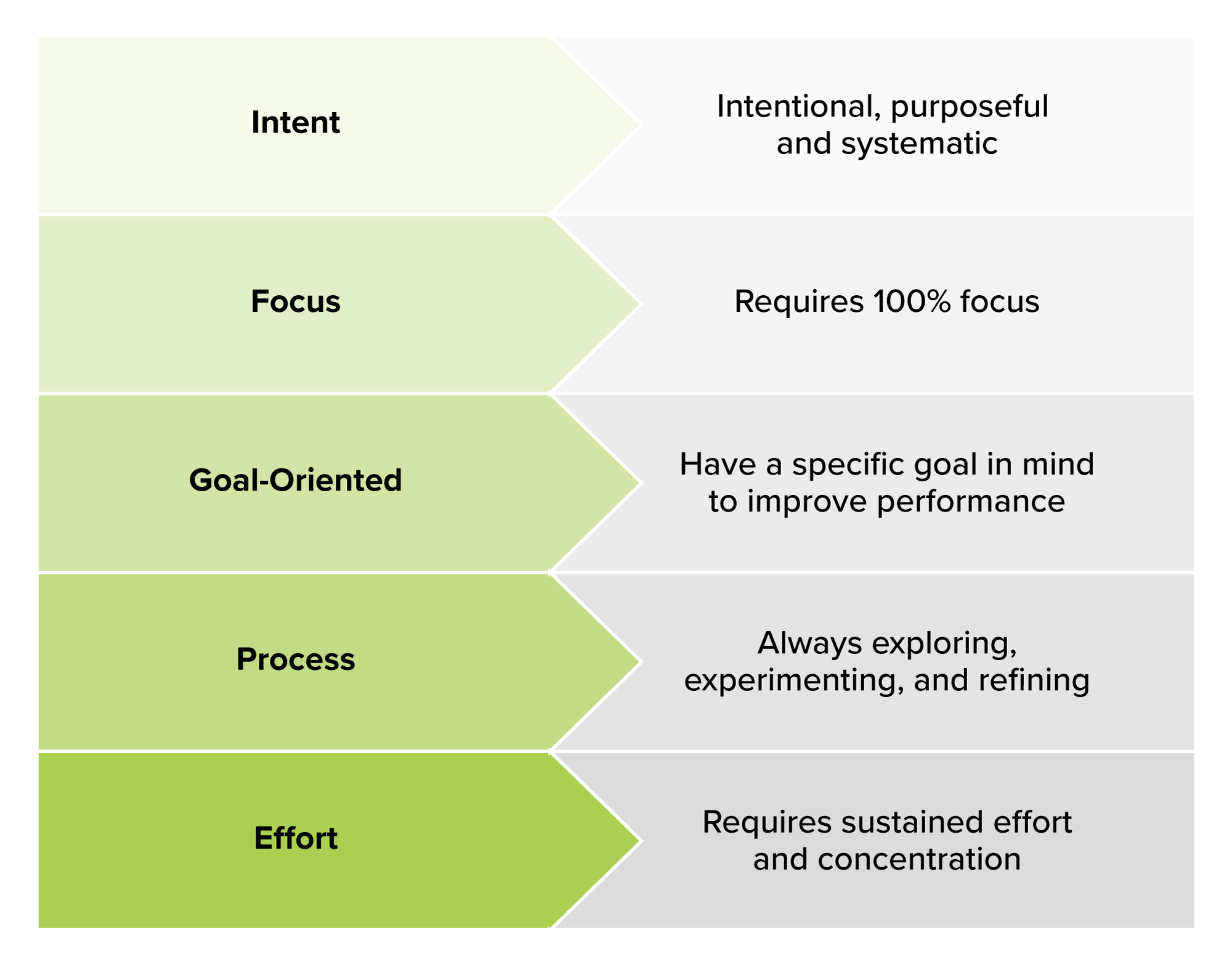
What is Deliberate Practice?

Intent
Intentional, purposeful, and systematic
Focus
Minimize distraction, 100% focus

Goal-Oriented
Specific goals improve performance

Process
Explore, experiment, and refine

Effort
Sustained effort and concentration
Myth 4: Engagement Signals Learning
In training and education, there is almost always an evaluation with questions about the extent to which the learners enjoyed the learning activity or class.
This myth equates learning with engagement. If learners are enthusiastic, active, collaborative, or entertained, learning is assumed to be happening.
Engagement is visible and affirming. Learning, by contrast, is often slow, effortful, and uncomfortable.
Research consistently shows that these experiences can diverge. Conditions that feel like there is enjoyable forward progress can produce illusions of understanding, while effortful practice, often experienced as something that is awful, produces more durable learning. Learners frequently feel they are learning more when they are learning less, and vice versa (Deslauriers et al., 2019; Bjork & Bjork, 2011).
The error here is an inferential one: these learner feelings about the experience are treated as evidence of cognitive outcome. Engagement matters, but only insofar as it supports the right kind of cognitive work. When it becomes the goal rather than the means, learning suffers (Deslauriers et al., 2019).

Invisible City, Wellington NZ sculpture is about how we see and acquire information.
Several years ago, I facilitated some Adaptive Thinking and Decision Making workshops in New Zealand, where I learned several important lessons about engagement and learning.
First, when project sponsor Lynda and I designed the workshop evaluation for participants, she said she would consider the workshop a failure if participants all said the workshop was enjoyable. Always wise, Lynda said if participants are not pushed past their comfortable ways of thinking, the workshop will not be achieving the aim of getting people to think differently preparing for future organizational challenges.
Why This Matters
These myths do not just distort classrooms or playing fields.
Individuals may confuse the feeling that information is easy to process or confidence is high with practice with mastery (Bjork & Bjork, 2011).
Organizations may substitute more training for more deliberately building expertise (Ericsson et al., 2018).
Leaders may mistake participation for readiness.
Caregivers may misinterpret enthusiasm or independence as learning progress.
Learning that Works
Debunking myths is not enough. Myths persist because they explain something people need to understand.
To displace them, we need better models of how learning works. Learning science provides those models. It explains why struggle can be productive, why guidance matters, why experience does not guarantee expertise, and why engagement is not the same as learning (Bransford et al., 2000; Brown et al., 2014; Sweller et al., 2011).
Everyone who makes learning decisions about themselves, their teams, their students, or the next generation, needs a working understanding of learning.
References
Bjork, R. A., & Bjork, E. L. (2011). Making things hard on yourself, but in a good way: Creating desirable difficulties to enhance learning. Psychology and the Real World, 2, 56–64.
Bransford, J. D., Brown, A. L., & Cocking, R. R. (Eds.). (2000). How people learn: Brain, mind, experience, and school. National Academies Press. https://doi.org/10.17226/9853
Brown, P. C., Roediger, H. L., III, & McDaniel, M. A. (2014). Make it stick: The science of successful learning. Harvard University Press.
Dale, E. (1946). Audiovisual methods in teaching. Dryden Press.
De Bruyckere, P., Kirschner, P. A., & Hulshof, C. D. (2015). Urban myths about learning and education. Academic Press.
Deslauriers, L., McCarty, L. S., Miller, K., Callaghan, K., & Kestin, G. (2019). Measuring actual learning versus feeling of learning in response to being actively engaged in the classroom. Proceedings of the National Academy of Sciences, 116(39), 19251–19257. https://doi.org/10.1073/pnas.1821936116
Ericsson, K. A., Pool, R., & Coyle, G. (2018). Peak: Secrets from the new science of expertise. Houghton Mifflin Harcourt.
Kirschner, P. A., Sweller, J., & Clark, R. E. (2006). Why minimal guidance during instruction does not work. Educational Psychologist, 41(2), 75–86. https://doi.org/10.1207/s15326985ep4102_1
Kirschner, P. A., & van Merriënboer, J. J. G. (2013). Do learners really know best? Educational Psychologist, 48(3), 169–183.
Pashler, H., McDaniel, M., Rohrer, D., & Bjork, R. (2008). Learning styles: Concepts and evidence. Psychological Science in the Public Interest, 9(3), 105–119.
Rogowsky, B. A., Calhoun, B. M., & Tallal, P. (2015). Matching learning style to instructional method: Effects on comprehension. Journal of Educational Psychology, 107(1), 64–78.
Sweller, J., Ayres, P., & Kalyuga, S. (2011). Cognitive load theory. Springer. https://doi.org/10.1007/978-1-4419-8126-4